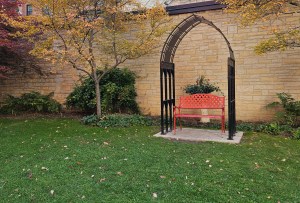
I spent much of last week in an old church building, an Anglican church building, on Elgin Street in Ottawa. Not quite as old as ours, and the hall that we used was bright and cheerful with comfortable chairs and a small kitchen. I didn’t attend church on Sunday morning… 😉 I was going to visit one of my colleagues’ churches, but we were starting at 10, which only allowed us to go to the Anglican or RC early services, so I took advantage of the glorious weather and went for a walk. ( I loved how this Presbyterian church down the road from where we met had this lovely little side yard).
There are quite a number of churches in downtown Ottawa, probably any number of them with the same sorts of challenges that churches here have. Majestic old buildings, built in another time and place, within a different society. Icons in a way, a reminder of the faith. For me, no matter where I go, I pick out the churches, I have no idea if people who are not connected to a faith community do. Is that something you do? Notice the churches in your travels?
The reading this morning is about King Solomon building the temple. God had made a covenant with Solomon’s father, David, promising that his descendants would rule over Israel. David desired to build a temple for God, but because of his involvement in warfare, God declared that this task would be accomplished by his son, Solomon. The temple was not just a religious structure but also a symbol of God’s presence, centralizing worship in Jerusalem. Before this, worship was primarily conducted at local altars or the portable tabernacle that had traveled with the Israelites since the time of Moses. The construction of a permanent temple in Jerusalem established the city as the religious and political heart of Israel. The temple was meant to be a house for the Ark of the Covenant, the sacred chest containing the tablets of the Law, symbolizing God’s covenant with Israel. Building the temple was an act of fulfilling God’s promise and establishing a permanent place for worship. Listen to these words from 1 Kings 5:
Now King Hiram of Tyre (which is modern day Lebanon) sent his servants to Solomon when he heard that they had anointed him king in place of his father, for Hiram had always been a friend to David. 2 Solomon sent word to Hiram, saying, 3 “You know that my father David could not build a house for the name of the Lord his God because of the warfare with which his enemies surrounded him, until he put them under the soles of his feet.[c] 4 But now the Lord my God has given me rest on every side; there is neither adversary nor misfortune. 5 So I intend to build a house for the name of the Lord my God, as the Lord said to my father David, ‘Your son, whom I will set on your throne in your place, shall build the house for my name.’
1 Kings 8 is a defining moment in the history of Israel, marking the transition from a nomadic, tabernacle-based worship system to a centralized, temple-based one in Jerusalem. It underscores the themes of God’s covenant faithfulness, the importance of worship, and the temple as the dwelling place of God’s glory. Solomon’s prayer of dedication reflects both humility and awe in the face of God’s majesty, recognizing that the temple, though a grand achievement, is ultimately a place where God’s infinite presence meets human frailty.
We continue in 1 Kings, chapter 8
827 “But will God indeed dwell on the earth? Even heaven and the highest heaven cannot contain you, much less this house that I have built! 28 Regard your servant’s prayer and his plea, O Lord my God, heeding the cry and the prayer that your servant prays to you today, 29 that your eyes may be open night and day toward this house, the place of which you said, ‘My name shall be there,’ that you may heed the prayer that your servant prays toward this place. 30 Hear the plea of your servant and of your people Israel when they pray toward this place; O hear in heaven your dwelling place; hear and forgive.
41 “Likewise when foreigners, who are not of your people Israel, come from a distant land because of your name 42 —for they shall hear of your great name, your mighty hand, and your outstretched arm—when foreigners come and pray toward this house,43 then hear in heaven your dwelling place and do whatever the foreigners ask of you, so that all the peoples of the earth may know your name and fear you, as do your people Israel, and so they may know that your name has been invoked on this house that I have built.
So, I got to thinking about this building and the ‘saints’ before us who envisioned and built it as a place of worship. A place for their time and place, just as Solomon built his for his time and place. The question that kept on rising was, what is the purpose of worship space?
What is the purpose of our worship space?
At this point I asked the congregation what they thought worship was for and these were their responses:
• to worship
• To come together
• to grieve
• form a sense of community to meditate
• to make music
• to celebrate
• to pray
• to feel peaceful
• to remember
• to carry on tradition
• to be a historic site
• to welcome
• to rejoice
• to support one another
• to learn
• to spread the word
• to be inspired
• to be inclusive
• to meet the sacred
All of those things are important… and ultimately are to equip us to live God’s mission in the world.
And here at St. James we have defined our part of God’s mission in the world as:
United in Faith
Strengthened by Friendship
Building a Community of Love and Justice
Does it matter then if we have pews or not? Or if we have a choir? Or if we have coffee in the sanctuary? Or what order the service is? Ultimately, the purpose of our worship space is not about the specific traditions we uphold or the physical structures we maintain.
Like Solomon’s temple, our church is meant to be a place where God’s presence meets us, a space where we gather to be strengthened and inspired for God’s mission in the world. Whether with pews or chairs, hymns or contemporary music, what matters most is that we are united in faith, strengthened by friendship, and committed to building a community of love and justice.
The question, then, is not about preserving the past, but about how our worship space can best serve God’s purposes in our time and place.
Thanks be to God for the challenge and the opportunity of being the church in this time and place, amen.
1 Kings 5:1-5
8:27-30, 41-43
October 27, 2024 – SJ
All Saints


 My Window on God's World