Pentecost is one of my favourite Sundays in the church year. Twenty years ago, I was ordained on Pentecost, and this stole was placed upon my shoulders for the first time, sign and symbol of servanthood.
Pentecost… the wind of the Holy Spirit swirling and dancing…
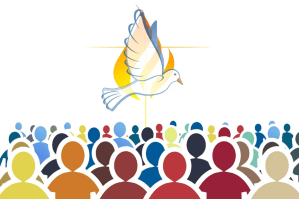
Pentecost… tongues of fire touching each one, empowering the frightened disciples.
Pentecost… passion, excitement and commitment unleashed upon the world.
Pentecost is a harvest festival, taking place fifty days after the Feast of the Passover. It’s a Jewish festival and symbols abound! The wind may remind us of God’s Spirit in creation. Fire may remind us of the pillar of fire that guided Moses and the people escaping from slavery. The languages were understandable and may represent how the gospel can transcend divisions and be relevant in any culture. If the precise details of Luke’s account may be unclear, the essential message is not: the followers of Jesus were changed from a timid group, hiding with their memories in the Upper Room, to a group inspired to change the world.
Let’s listen, as the story unfolds in Acts 2: 1-21:
2 1-4 When the Feast of Pentecost came, they were all together in one place. Without warning there was a sound like a strong wind, gale force—no one could tell where it came from. It filled the whole building. Then, like a wildfire, the Holy Spirit spread through their ranks, and they started speaking in a number of different languages as the Spirit prompted them.
5-11 There were many Jews staying in Jerusalem just then, devout pilgrims from all over the world. When they heard the sound, they came on the run. Then when they heard, one after another, their own mother tongues being spoken, they were blown away. They couldn’t for the life of them figure out what was going on, and kept saying, “Aren’t these all Galileans? How come we’re hearing them talk in our various mother tongues?
Parthians, Medes, and Elamites;
Visitors from Mesopotamia, Judea, and Cappadocia,
Pontus and Asia, Phrygia and Pamphylia,
Egypt and the parts of Libya belonging to Cyrene;
Immigrants from Rome, both Jews and proselytes;
Even Cretans and Arabs!
“They’re speaking our languages, describing God’s mighty works!”
12 Their heads were spinning; they couldn’t make head or tail of any of it. They talked back and forth, confused: “What’s going on here?”
13 Others joked, “They’re drunk on cheap wine.”
14-21 That’s when Peter stood up and, backed by the other eleven, spoke out with bold urgency: “Fellow Jews, all of you who are visiting Jerusalem, listen carefully and get this story straight. These people aren’t drunk as some of you suspect. They haven’t had time to get drunk—it’s only nine o’clock in the morning. This is what the prophet Joel announced would happen:
“In the Last Days,” God says,
“I will pour out my Spirit
on every kind of people:
Your sons will prophesy,
also your daughters;
Your young men will see visions,
your old men dream dreams.
When the time comes,
I’ll pour out my Spirit
On those who serve me, men and women both,
and they’ll prophesy.
I’ll set wonders in the sky above
and signs on the earth below,
Blood and fire and billowing smoke,
the sun turning black and the moon blood-red,
Before the Day of the Lord arrives,
the Day tremendous and marvelous;
And whoever calls out for help
to me, God, will be saved.”
Debie Thomas, in her lectionary essay wrote this: The story Luke describes is a fantastical one, full of details that challenge the imagination. Tongues of fire. Rushing wind. Bold preaching. But at its heart, the Pentecost story is not about spectacle and drama. It’s about the Holy Spirit showing up and transforming ordinary, imperfect, frightened people into the Body of Christ.
It’s about God disrupting and disorienting our humdrum ways of engaging the sacred, so that something new and holy can be born within and among us. It’s about the Spirit carrying us out of suspicion, tribalism, and fear, into a radical new way of engaging God and our neighbor. (Debie Thomas – Journey with Jesus)
Almost five years ago, the folks here at St. James held a vote on becoming an Affirming congregation. Five years ago you said a resounding YES! to something that would have been unthinkable for many folks 10, 20, 30 years ago! Five years ago, you said YES! to the idea that you would give love a greater voice than fear. While I wasn’t here, I like to think of it as a Pentecost moment for you! A time when the Holy Spirit blew through this place, encouraging, inspiring and enlivening you.
Of course, it wasn’t a single moment… it was moments and moments of saying yes… it was transformed hearts and minds… it was prayer and learning, it was pain and promise… And ultimately, you spoke the language of love. Love of diversity. Diversity of age, race, ethnicity, sexual orientation, ability and economic circumstance.
The Pentecost story might be understood as a story of justice and equity. The Jewish pilgrims who had gathered from a variety of countries, heard their language being spoken; the Holy Spirit did not have to be translated. And the language was love. In a society that was stratified by whether you were Jew or Gentile, servant or free, woman or man, rich or poor, the early Christian communities were defined by love. Further on in the book of Acts, we are told that those early communities held everything will each other, so that there was no one in need among them… sharing was the language of love.
They served meals that served the poor and needy, so matter the background… food was the language of love. They tended to the sick… healing was the language of love… They integrated the marginalized of society… inclusion was the language of love… They were following the example of Jesus… who drew upon the best of his Jewish heritage and teachings, which he summed up with the words, “Love God and love your neighbour as yourself.”
How is the Holy Spirit blowing through our churches now? Who is seeing visions… and who is dreaming dreams? What language of love are we being called to speak, embody and live? speak?
Thanks be to God for the challenge and the opportunity of responding to the voice of the Holy Spirit.
Acts 2: 1-21
May 19, 2024 – SJ


 My Window on God's World