Bank of Dave is a 2023 British biographical comedy-drama film that tells the true-ish story of Dave Fishwick, a self-made millionaire from Burnley, England. Frustrated by the traditional banking system’s refusal to lend to local businesses, Dave decides to set up his own bank, with the goal of helping his community. Despite facing numerous challenges, including resistance from financial regulators and established banks, Dave persists in his mission to create a bank that genuinely serves the people.
When we hear a story about one man or person standing up against a incredible odds what is a biblical story that we think about? David and Goliath right? Even the names are the same!
Here is a summary of the David and Goliath story, for those who need a little refresher!
It’s found in the book of 1 Samuel, chapter 17. It takes place during a period of conflict between the Israelites and the Philistines, around the 11th century BCE. The Philistines were a powerful sea-faring people who often clashed with the Israelites, a smaller and less militarily advanced nation. At this time, the Israelites were led by King Saul, but they were struggling under the constant threat of the Philistines. The two armies faced off in the Valley of Elah. The Philistines, confident in their superiority, proposed a single combat to decide the outcome of the battle. Their champion, Goliath, was a giant warrior, said to be over nine feet tall, clad in heavy armor and wielding a massive spear.
Goliath taunted the Israelites, challenging them to send out a warrior to fight him in single combat, but no one dared to face him.
David, a young shepherd boy, was the youngest son of Jesse and not a soldier by profession. He was sent by his father to deliver food to his older brothers, who were part of Saul’s army. When David arrived at the battlefield, he heard Goliath’s taunts and was surprised that no one had the courage to fight him. Filled with faith in God, David volunteered to fight Goliath, despite his lack of armour or experience. Saul, hesitant but desperate, agreed and offered David his own armor, but David declined, saying it was too heavy and cumbersome. Instead, David chose to face Goliath armed only with a sling, five smooth stones, and his trust in God. When Goliath saw the young, unarmoured David approaching, he mocked him, but David responded with confidence, declaring that he came in the name of the Lord. As Goliath advanced, David swiftly slung a stone that struck Goliath in the forehead, killing him instantly, demonstrating that faith and courage can overcome even the greatest of odds.
The story of David and Goliath is often seen as a classic underdog tale, symbolizing the triumph of the small and weak over the powerful and mighty through faith, courage, and determination. It has been used metaphorically throughout history to represent the victory of righteousness over evil and the potential for anyone, regardless of size or status, to achieve greatness with divine support. David would later become one of Israel’s greatest kings, and this event marked the beginning of his rise to prominence.
David is not the only story of how one person made a difference and changed the course of history. Somehow, we don’t celebrate or hear about Esther nearly as often as we do David, but let’s hear some of her story! Her story, in the Book of Esther, is set during the Persian Empire in the 5th century BCE, under King Xerxes I.
Many Jews lived in exile in Persia after the Babylonian captivity. Esther, a young Jewish woman raised by her cousin Mordecai, is chosen to be queen after King Xerxes deposes his former queen, Vashti. She is deposed because she refuses to appear naked in front of the king’s banquet guests. Esther conceals her Jewish identity at Mordecai’s advice. Haman, a high-ranking official, despises Mordecai and convinces Xerxes to issue a decree to annihilate all Jews in the empire. Mordecai urges Esther to intervene. Initially hesitant, Esther bravely approaches the king, risking her life, and invites him and Haman to a banquet. There, she reveals her Jewish heritage and Haman’s plot. Furious, Xerxes orders Haman’s execution and allows the Jews to defend themselves against their enemies, leading to their salvation. Esther’s story is celebrated during Purim and highlights themes of courage, identity, and divine providence, showing how an ordinary person can make an extraordinary impact.
So, there we have three stories of the impact of individuals. But, as John Donne said, “No man is an island.” Let’s watch this video that speaks about the importance of being the second person after the leader.
We like to have heroes and sheroes… but the reality is nobody succeeds on their own. Yes, one person can make a difference, but a group of people acting together can change the world. Do you feel helpless against huge systems? Like homelessness, or even rising rents? Climate change? Hunger? I hear you; I often feel that way too. So much so that I sometimes just want to climb into bed and pull the covers up over my head and read trashy novels and forget about everything except what effects me personally.
Each of those stories we heard today imagined a different way of the world operating: Dave from Burnley, David and Esther, they all took risks and while their stories may sounds as if they did it on their own, when we delve into the stories a little more, we discover that they all had supporters. People who were like that second and third person on the hill on the video that we just watched. An individual without followers who speaks of a different way of being is just an insurgent or renegade. Or a fool! But once people gain followers, it becomes a movement.
We have a very local example of how people came together to protest the infilling of the Dartmouth Cove…

Jill Brogan spearheaded the movement, but if nobody had gotten behind her, nothing would have happened. I don’t know how many of you have been following the events as they have unfolded about this situation. And I may not have all the details right. What I do know is that on Wednesday, the owners of the water lot, which kind of blows my mind, how a company can own a water lot, placed fences at either end of the trail.
Citizens dismantled them, but later that day, they brought concrete barriers.


Both Sam Austin (City Councilor) and Claudia Chender (MLA) have been supportive of the Save Dartmouth Cove group to keep the trail as a community space.The city sent a letter to the company saying that the barriers need to be removed by Friday at noon or they would remove them and bill the company for the cost. And they were removed.
Here is Jill Brogan again, on Friday afternoon after they were removed. One person, spearheaded a movement, but she didn’t do it alone. And it will have impact on our city for decades to come.

Jesus spoke about a different way of life and living… but without his followers he may have remained a fringe element within the Jewish community. After all, he was preaching a very different way of modelling society, not different from his Jewish background, but different from the Roman oppression in which the Jewish people were forced to live. We all know what happened to him don’t we. When most of his followers deserted him… only the women stayed at the cross.
The next reading is from Acts, which is a continuation of the Gospel of Luke. The events in Acts 4 take place shortly after Jesus’ resurrection and ascension, during the early days of the Christian church in Jerusalem. The apostles, particularly Peter and John, were leading the fledgling community, preaching about Jesus and performing miracles.
The Holy Spirit had descended upon the believers at Pentecost (Acts 2), empowering them to spread the gospel with boldness.
32 Now the whole group of those who believed were of one heart and soul, and no one claimed private ownership of any possessions, but everything they owned was held in common. 33 With great power the apostles gave their testimony to the resurrection of the Lord Jesus, and great grace was upon them all. 34 There was not a needy person among them, for as many as owned lands or houses sold them and brought the proceeds of what was sold. 35 They laid it at the apostles’ feet, and it was distributed to each as any had need. 36 There was a Levite, a native of Cyprus, Joseph, to whom the apostles gave the name Barnabas (which means ‘son of encouragement’). 37 He sold a field that belonged to him, then brought the money, and laid it at the apostles’ feet.
This passage illustrates the radical nature of early Christian discipleship. The believers were not merely united in faith but in practice, living out Jesus’ teachings on love, generosity, and care for the poor. Their communal lifestyle was a powerful witness to the surrounding society, demonstrating the transformative impact of the gospel. The historical context also underscores the challenges faced by the early church, including the tension between their radical new way of life and the existing social, religious, and economic structures of the time. Despite these challenges, the early Christians’ commitment to one another and to the mission of spreading the gospel was unwavering, setting the foundation for the growth of the church.
So, the big so what! One of my preaching professors always use to say, there had to be a so what to a sermon. So what difference does this make to my life? What difference does this make to how we are communities of faith? I woke up one morning a couple of weeks ago with a vision.
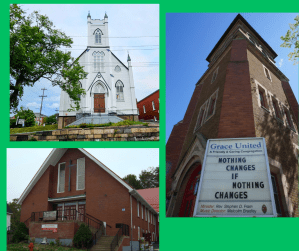
Our two churches, Grace and St. James are pretty similar as far as we are situated more or less in the same community and serve the same demographic. There’s another church, Stairs, only about 2 km away, but serves a very different community.
It has a Food Bank that serves on average 87 families including 97 children, per week. It also has an incredible outreach ministry to low income and immigrant families. Families that cannot contribute financially to the church.
Now, I know the word amalgamation is a loaded one… and that’s not what my vision is. My vision is the three churches coming together and having some facilitated conversation about how best to serve Downtown and North Dartmouth. Not just some pie in the sky idea about cooperating, but some challenging conversations. Conversations where we invest our resources of time and money. What kind of energy could we unleash if we were focused more on what our community needed and less on having our wants satisfied? It can’t be just my vision, can it be our vision?
As I studied the scripture passage from Acts, the last two sentences suddenly took on intense importance: There was a Levite, a native of Cyprus, Joseph, to whom the apostles gave the name Barnabas (which means ‘son of encouragement’).
37 He sold a field that belonged to him, then brought the money, and laid it at the apostles’ feet.
Son of encouragement was the phrase that caught my attention. The world is full of people who will say it can’t be done… until someone is doing it. Can we be sons and daughters of encouragement?
- Congregations intent on serving their neighbours will live.
- Congregations focused on our neighbours and partnering with other organizations rather than survival will live.
- Congregations who understand that their minister can no longer be the sole provider of worship leadership, vision, pastoral care, education will thrive.
- Congregations who realize that it’s not about having the right logo, the right sign, or the young minister, will live.
Thriving congregations are about spiritual depth, authentic relationships, and genuine hospitality. (Created from a blog post written by Jan Edmiston – she had written all of these things in the negative, I wrote them in the positive. https://achurchforstarvingartists.blog/)
Each one of us has the capacity to both lead and follow in those roles.
As we’ve explored today, stories like those of Dave Fishwick, David, and Esther and Jill Brogan remind us that while individual courage is crucial, true transformation often requires the support and collective action of a community. Each of these figures stood firm in their convictions, but they were not alone—they had the backing of others who shared their vision and helped turn it into reality. In the same way, our own efforts, while important, are magnified when we work together.
The early Christians in Acts 4 demonstrated this by living in radical community, sharing all they had to ensure no one was in need. As we reflect on our own communities, let’s embrace this spirit of unity and collaboration, recognizing that when we come together with a shared purpose, we can create meaningful change. May this vision of collective action guide us as we seek to serve not just ourselves, but the wider world around us.
Thanks be to God for the challenge and the opportunity of following Jesus, amen.
Scripture – 1 Samuel 16, 17, 18, 19 – Selected Verses
Esther 2 – Selected Verses
Acts 4: 32-37
August 25, 2024 – St. James
Reel Theology – Bank of Dave
© Catherine MacDonald


 My Window on God's World
Thank you for your message, Rev. Catherine. My daughter and her husband, Sandra and Jim Preeper, are great supporters of Jill Brogan and the efforts to keep Dartmouth Cove open.
Shirley Morash