
450 grams of dry rice or some other grain.
50 grams of beans/lentils of some sort.
50 grams of oil.
5 grams of iodized salt.
That is a day’s worth of emergency food aid. And this is what it looks like as one of three meals a day.
As most of you know, I was in Ottawa a couple of weeks ago attending a Canadian Foodgrains Bank event called Hunger on the Hill.
Canadian Foodgrains Bank is a Christian response to world hunger. They are a partnership of 15 church and church-based agencies working together to end global hunger. They support programs implemented by their member churches and agencies through their local partner organisations in countries around the world. (https://foodgrainsbank.ca/)
Here’s a few statistics:
- There are about 757 million people in the world experiencing hunger
- Nearly 98% of people experiencing hunger live in developing countries
- Around 80% of displaced persons live in countries affected by long-term hunger.
So, what was this event called Hunger on the Hill and why was I there?
We were there to discuss resilient agrifood systems and the upcoming climate finance package with MPs.
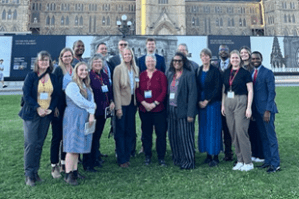
Before the group of 17 of us even arrived in Ottawa we had had 2 evening sessions of online training about world hunger and the Canadian Foodgrains Bank. You can see us there, a wide range of ages, and ethnic backgrounds, there were three United Church clergy, all participants were people of faith, and it was wonderful to be with people who unapologetically talked about their faith as the reason for being involved in this.
So our time in Ottawa was spent deepening that knowledge, learning how to conduct interviews with MPs, how to do research on MPs, how to best tailor our message so that they could hear us, and to ask for their support.
Canada’s climate finance commitment is currently up for renewal and the Canadian Foodgrains Bank is asking for increased investments in those areas helping people adapt to extreme weather events and pursue sustainable livelihood over the long term and self-sufficiency.
We were given tips on how to speak to the various parties because we were meeting with all parties. We went out in teams of three or four and the expectation was that if you were meeting with your own MP, and we had all been asked to write a letter to our MP asking for a meeting, if we were meeting with our own PM P we were taking the lead on that meeting.
Part of me was relieved that my own MP had not responded to my letter requesting a meeting until about 3 pm the afternoon before our meetings, we got word that he had agreed to one at 9:30 the next morning. He was gracious, interested and promised his support for the things we asked and the Canadian Foodgrains Bank makes it really easy for them to do so. There was someone to take notes, so one of the things we asked was whether or not he would write letters to the Prime Minister and Minister of Finance. Staff from Canadian Foodgrains Bank will follow up with templates of those letters that the staff person for that MP can quickly adapt it and send it out.
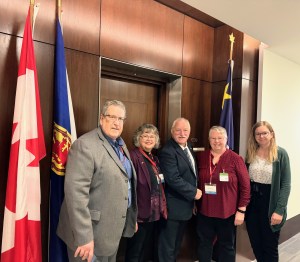
Here we are, at the end of the meeting. I have never aspired to be a politician… but I have to say, I was inspired by some of the ones I met two weeks ago. They have a thankless job and they work from morning till night. They work really hard… what you see in Question Period is not indicative of what the average MPs life is like.
We had an opportunity to attend Question Period in person and while I never watch it, because I can’t stand it, I was really glad to see it live. My claim to fame right now is that I was chastised by the Parliamentary Security Staff for leaning over the railing of the gallery. We were sitting in the first row on the liberal side and I was trying to see who was there, apparently you are not supposed to lean over. They take everything away from you before you go into the gallery: purse, wallet, ID, phone, even my smartwatch! I felt sort of naked. It was also the 10th anniversary of the shooting of Nathan Cirilo, the reservist who was guarding the Tomb of the Unknown Soldier, so security was heighted that day.
I came home inspired and encouraged both by the MPs and by the Canadian Foodgrains Bank; my Continuing Education Allowance paid for my registration and flight, but once I was there, my hotel and meals were covered. I hope that next year, we can send someone from the congregation to take part who can be similarly inspired and encouraged.
So, what has this got to do with our scripture reading for today? Turns out, quite a lot, I didn’t even have to change the reading for the day in order to make it fit! 😉
1 Kings 17:1-17 introduces the prophet Elijah during a critical period in Israel’s history under King Ahab’s rule. It’s the beginning of Elijah’s prophetic ministry. Ahab, had led the northern kingdom into the worship of Baal, a Canaanite deity associated with fertility and rain. As a direct challenge to Baal worship, Elijah, proclaims a drought, showing that the God of Israel controls the rain and life, not Baal. This drought is intended as judgment for Israel’s infidelity and as a means to demonstrate God’s supremacy. Afterward, God instructs Elijah to hide by the Kerith Ravine, where he is miraculously sustained by ravens bringing him bread and meat—a testament to God’s provision even in desolation. When the brook eventually dries up, God sends Elijah to Zarephath, a region outside of Israel and within the realm of Baal worship, to find a widow who will provide for him. Despite her own dire poverty, the widow obeys Elijah’s request, and God miraculously sustains her household with flour and oil that never run out.
Let’s listen as the story unfolds in I Kings, chapter 1:
17 Now Elijah the Tishbite, of Tishbe[a] in Gilead, said to Ahab, “As the Lord the God of Israel lives, before whom I stand, there shall be neither dew nor rain these years, except by my word.”
2 The word of the Lord came to him, saying, 3 “Go from here and turn eastward, and hide yourself by the Wadi Cherith, which is east of the Jordan. 4 You shall drink from the wadi, and I have commanded the ravens to feed you there.”
5 So he went and did according to the word of the Lord; he went and lived by the Wadi Cherith, which is east of the Jordan. 6 The ravens brought him bread and meat in the morning and bread and meat in the evening, and he drank from the wadi. 7 But after a while the wadi dried up because there was no rain in the land.
8 Then the word of the Lord came to him, saying, 9 “Go now to Zarephath, which belongs to Sidon, and live there, for I have commanded a widow there to feed you.”
10 So he set out and went to Zarephath. When he came to the gate of the town, a widow was there gathering sticks; he called to her and said, “Bring me a little water in a vessel, so that I may drink.” 11 As she was going to bring it, he called to her and said, “Bring me a morsel of bread in your hand.”
12 But she said, “As the Lord your God lives, I have nothing baked, only a handful of meal in a jar and a little oil in a jug; I am now gathering a couple of sticks so that I may go home and prepare it for myself and my son, that we may eat it and die.”
13 Elijah said to her, “Do not be afraid; go and do as you have said, but first make me a little cake of it and bring it to me, and afterward make something for yourself and your son. 14 For thus says the Lord the God of Israel: The jar of meal will not be emptied and the jug of oil will not fail until the day that the Lord sends rain on the earth.”
15 She went and did as Elijah said, so that she as well as he and her household ate for many days. 16 The jar of meal was not emptied, neither did the jug of oil fail, according to the word of the Lord that he spoke by Elijah.
Scarcity into abundance… a little meal… a little oil… and it didn’t run out… Why do you suppose God sent Elijah to that widow? He’s deep into foreign territory, the widow isn’t someone who is governed by the laws of hospitality and care for the stranger.
Imagine being so desperate that she and her son are going to eat the last of their food and lie down and die, presumably of hunger.
And here she is being asked by this stranger, to not only feed him, but also to trust him that the food won’t run out! I’m not sure I’d be so willing… Doesn’t it speak to stories that we read or hear about how deeply hospitality is embedded in the Middle East? Do you remember Bill Chambre, the Ecumenical Accompanier in Israel speaking last year about a family who had just had their home bulldozed down around them, still insisted on providing some food and drink for them as observers?
This story also speaks to me about the fact that there is enough food in the world. Do you know what the leading causes of hunger are around the world?
- Poverty and Inequality. Hunger and poverty go hand-in-hand.
- Conflict. Conflict is a key reason why the number of people facing hunger in the world today has been rising in recent years.
- Food system failures.
- Climate change and natural disasters.
In most parts of the developed world, our challenge is too much food. We waste it, we overeat, we have health related issues related to overeating.
Canadian Foodgrains Bank started 40 years ago when some farmers on the prairies had a bumper crop, which coincided with a famine in parts of Africa and so grain was sent. I’m not sure when actual food stopped being sent, it’s a very ineffective way to feed hungry people. And quite costly.
While there are still growing projects in various parts of the country, now the grain is sold and the money donated to be used by Canadian Foodgrains Bank’s partner agencies.
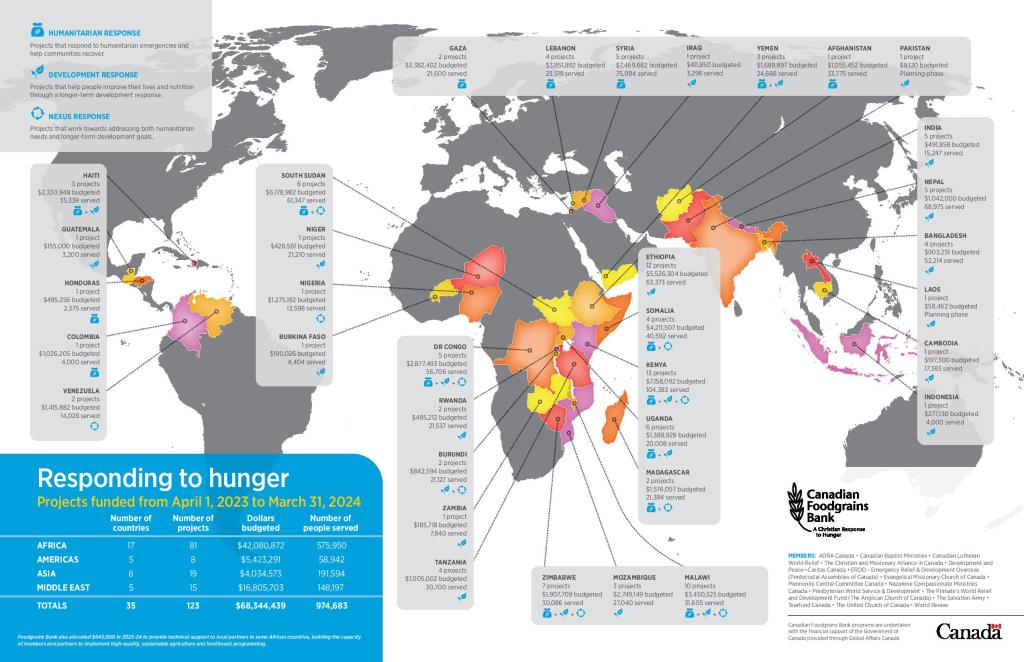
You can see from the map below what projects were funded last year.
Now, I know, that some of you are thinking that we have hungry people here in Canada and wondering if they shouldn’t be our first priority? It’s a fair question. We do have a hunger crisis in Canada too. My response is based on both Jesus and practical. Jesus said the greatest commandment was to love God, love self and love neighbour. He learned that from his scriptures, what we call the Old Testament, the widow of Zapareth fed Elijah as neighbour.
And he challenged the people of his time to consider everyone neighbours. So, who is our neighbour?
The other is practical. If we don’t enable and empower developing countries to feed themselves, we will be faced with ever increasing humanitarian crises. And you know that Canada ALWAYS responds to humanitarian crises. And that usually winds up costing more money, than empowering local communities, through education and training to feed themselves better.
I think we can do both… advocate to end hunger both within Canada and around the world. I already know you are concerned with feeding people. Maybe that can be our focus this coming year. Working to end hunger both locally and globally.

In reflecting on 1 Kings 17:1-17 and the work of the Canadian Foodgrains Bank, we are reminded of God’s provision and our call to act with compassion and justice.
Elijah’s encounter with the widow at Zarephath highlights God’s power to turn scarcity into abundance and challenges us to trust in divine provision. Yet, it also calls us to be participants in that abundance, sharing our resources and advocating for a world where no one goes hungry.
Just as Elijah brought hope to a widow on the brink of despair, we too are called to bring hope through our actions, ensuring that both our local communities and our global neighbors have enough. May we trust, like the widow, that even small acts of faith can lead to great miracles, and may we, in turn, work to end global hunger.
Thanks be to God for the challenge and the opportunity, amen.
1 Kings 17: 1-17
November 3, 2023 – SJ
© Catherine MacDonald


 My Window on God's World