One summer, about 35 years ago, a twelve-year-old boy from Northern Ireland stayed with my family and I. He was among about 40 children ages 10-12 who came to Nova Scotia that year. These were children from a boys and girls club in Belfast, a town noted for its religious intolerance, violence and terrorism. These children were both Protestant and Catholic and were brought to Canada by the Irish Canadian Society. These children were brought to Canada for a couple of reasons. One was simply to give them some respite from the tensions of home. And the other was to show them what a society without violence along religious lines could be like.
We had a wonderful summer, Gerard and my son, who was also 12, had many interests in common, spent hours riding their bikes and fishing, and he quickly became a part of our family. Gerard seemed like an average kid with good and not so good qualities and a flair for practical jokes. The only time I noticed any tension was during the first days when my husband was wearing his Navy uniform. But since we were on vacation shortly after Gerard arrived, I quickly forgot about it. There didn’t seem to be much to separate him from Mathew’s other friends, until one day he was a bit homesick, so I suggested that we place a call to his mother.
This was a Friday evening, when we called, there was no answer, we tried again later, still no answer, and again later still, and again there was no answer. By this time Gerard was becoming quite agitated and upset. In fact there was no answer all weekend. He said things to me like: “My mother never is out this late, something must have happened to her.” And, “There may have been a bombing.” And, “You don’t know what it is like.” He was right, I didn’t know, and I still don’t know what it is like to live under that threat of potential violence. Before I go any further, I should tell you that his mother was okay, she had taken the opportunity of her son being away to visit a friend in another town for the weekend.
But this event made me realize that he was very different from my son and his friends. He lived with the reality of bombs exploding, and having relatives killed. He lived with a military presence in his streets, a military that was heavily armed and equipped for battle. He lived with the darkness of uncertainty. I had been thinking of him as a child of the light, with no other worries that any other twelve-year-old boy. But he was also a child that lived with darkness. One whose knowledge was of things that I can only comprehend intellectually. One whose entire world could come crashing down on him at any time. One who couldn’t trust in tomorrow, in the same way that most of us trust in tomorrow.
Listen to these words from Thessalonians
Now concerning the times and the seasons, brothers and sisters, you do not need to have anything written to you. For you yourselves know very well that the day of the Lord will come like a thief in the night. When they say, “There is peace and security,” then sudden destruction will come upon them, as labor pains come upon a pregnant woman, and there will be no escape! But you, beloved, are not in darkness, for that day to surprise you like a thief; for you are all children of light and children of the day; we are not of the night or of darkness. So then let us not fall asleep as others do, but let us keep awake and be sober; for those who sleep, sleep at night, and those who are drunk get drunk at night. But since we belong to the day, let us be sober, and put on the breastplate of faith and love, and for a helmet the hope of salvation.
For God has destined us not for wrath but for obtaining salvation through our Lord Jesus Christ, who died for us, so that whether we are awake or asleep we may live with him. Therefore encourage one another and build up each other, as indeed you are doing.
Christians in Thessalonica, or modern-day Greece faced considerable social pressure and persecution from both the Jewish and Gentile communities. For instance, they were seen as disruptive to traditional social norms, including loyalty to the emperor, local deities, and traditional customs. They were one of the earliest Christian communities, and given the hostile environment, Paul’s emphasis on faith, hope, and mutual encouragement was a call for unity and resilience. These believers needed support as they navigated their faith in a society that often opposed them. The language of light and darkness, common in Jewish thought and other ancient texts, symbolized moral and spiritual clarity versus ignorance and moral compromise. So Paul was encouraging them to remember Jesus, to keep the faith, even though forces around them were working against them.
Sometime over the intervening years, we lost touch with Gerard and his family, remember, these were pre-internet days. I would read stories on the news of Ireland and wonder what his life was like. For a long time, I worried about him… wondering what his tomorrows had brought him… For a long time, I wondered if he was one of those angry young men who seem attracted to violence as a way of solving problems?
But something has happened in Ireland over the intervening years… there is peace… peace… after centuries of fighting and bombs and terrorism… Not only peace, but also some economic prosperity… the two go hand in hand. Ireland is now a story of hope… no it is not perfect… but it does demonstrate that war and violence don’t have to be the final answer. And so, while I would still like to know what his tomorrows have brought him, I have stopped worrying about him.
Five years ago, I went to Northern Ireland, in fact spent a few days in Belfast, before heading to Corrymeela for a Peace and Reconciliation event. And I looked for Gerrard in the faces of the now ‘not so young men’ and once again wondered about him.
We had a ‘Tour of Terror’ murals on the walls of buildings, where there were checkpoints, where British soldiers were stationed at every corner, barbed wire and fencing corralled the city center. Now, it’s a vibrant shopping district.
I tell this story because if you had asked people on the streets in Belfast in the 70s if they thought anything would change, they would probably have said no. And yes, with continued perseverance, perseverance by ordinary people, and the refusal to become enslaved by the violence and oppression, peace and prosperity rule the streets of Belfast.
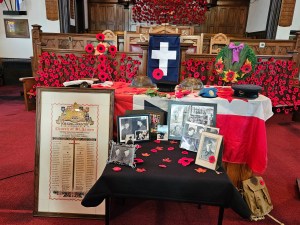
Next Saturday is Remembrance Day. A day set aside to remember all men, women and children who have died and who continue to die as a result of war. They lost their tomorrows. And we lost their tomorrows. The world lost and continues to lose the potential of so many people. Not just people living in this wonderfully safe country of ours… but people all over the world. My father was in the Air Force, I grew up on air force bases in various parts of the country… my ex-husband and all of my brothers-in-law were in the navy… I have a nephew who served in Afghanistan and another nephew who just left the army… I have the utmost respect and pride in our forces… but I wish they weren’t necessary…
At the beginning or the middle of any sort of conflict, struggle or challenge, we have no idea of the outcome. The men and women who went off to serve in the two world wars had no idea if they would come home, or if they would have a home to come home to. And yet they went. And the people who stayed behind, the women and the older men and the children, they persevered. They were bleak days, days when there was nothing but bad news.
And it may seem like that now too. In seems impossible that our brothers and sisters to the south have elected, for the second time, a man who stands against everything that we stand for as a church. Love God, love neighbour, love self. Feed the hungry, welcome the stranger, visit the sick and imprisoned. And we mustn’t be too smug, because we have those same elements here.
And there is the temptation, or at least I have the temptation to hunker down and be like a turtle and pretend it isn’t happening, or to pretend that there is nothing we can do about it. It’s easier not to stick my head out, then to perhaps get it snapped off!
I follow a number of highly intelligent women on social media.
One of them is Rebecca Solnit. She wrote this on November 6th: They want you to feel powerless and to surrender and to let them trample everything and you are not going to let them. You are not giving up, and neither am I. The fact that we cannot save everything does not mean we cannot save anything and everything we can save is worth saving. You may need to grieve or scream or take time off, but you have a role no matter what, and right now good friends and good principles are worth gathering in. Remember what you love. Remember what loves you. Remember in this tide of hate what love is. The pain you feel is because of what you love. People kept the faith in the dictatorships of South America in the 1970s and 1980s, in the East Bloc countries and the USSR, women are protesting right now in Iran and people there are writing poetry. There is no alternative to persevering, and that does not require you to feel good. You can keep walking whether it’s sunny or raining. Take care of yourself and remember that taking care of something else is an important part of taking care of yourself, because you are interwoven with the ten trillion things in this single garment of destiny that has been stained and torn, but is still being woven and mended and washed. https://www.instagram.com/p/DCCL-N2uqTj/?hl=en
Brené Brown writes this: Despair is a claustrophobic feeling. It’s the emotion that says, “Nothing will ever change.” It’s different than anger or sadness or grief. Despair is twinged with hopelessness. The research shows that hope is a powerful antidote to despair. What’s interesting, however, is that hope is not an emotion (C. R. Snyder). Hope is a cognitive-behavioral process. It’s about having a goal, a pathway to achieve that goal, and a sense of agency or “I can do this.” Right now, the thing that is helping the most is micro-dosing hope. I have no access to big hope right now, however, I am asking myself how I can support the people around me. Doing the smallest next right thing is hard AF, but sometimes it’s all we’ve got.
As Paul said in the reading, “And so encourage one another and help one another, just as you are now doing.” No, none of know when the hour of our death is at hand. That is why we are called to live in the light. The light of Christ’s redeeming love. We are called to remember Christ’s action in the world. But remembering is not enough. We must live Christ’s action in the world.
Thanks be to God for that challenge and opportunity. Amen.
1 Thessalonians 5: 1-11
November 10, 2024
Remembrance Day – St. James


 My Window on God's World