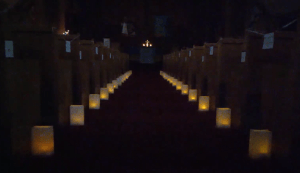
There is a particular quiet that comes at this time of year. It is not the quiet of peace on earth or the hush that falls over a snow-covered landscape. It’s a deeper quiet, the kind that settles into the heart when life has asked more of us than we expected to give. A quiet that comes with grief, with change, with disappointment, with the tender ache of remembering what used to be and the fear of what may never be again.
For many of us gathered tonight, this season does not feel like the commercials or the carols or the carefully lit storefront windows. Instead, it feels like we are carrying something heavy through a world that insists we should be light.
And so we gather in the dark , not to escape it, but to honour it.
Because darkness is honest. It does not pretend.
Because darkness is where seeds grow.
And because, as the gospel writer tells us, “The light shines in the darkness, and the darkness did not overcome it.”
In the beginning was the Word, and the Word was with God, and the Word was God. He was in the beginning with God. All things came into being through him, and without him not one thing came into being. What has come into being in him was life, and the life was the light of all people. The light shines in the darkness, and the darkness did not overtake it.
John begins his story of Jesus not with a manger, not with shepherds or angels or a star, but with mystery: In the beginning was the Word. This “Word” is not simply speech or doctrine. It is presence. Breath. The pulse of life itself. Before everything else, before creation, before history, before our memories and mistakes, there is a holy presence that speaks light into being.
But the passage doesn’t shy away from the reality that darkness exists. It doesn’t tell us to pretend we’re fine, or to force happiness because the calendar says it’s December. Instead, it names the truth: darkness is part of the story. And the light does not erase it or rush past it, the light shines in it.
That’s what makes this night different. This is not a night of pretending. This is a night of telling the truth about how complicated it is to be human and how brave it is to love and lose and keep living.
Stanley Kunitz’s poem “The Layers” is another companion for us tonight. He wrote it late in his life, looking back at the “many lives” he had lived, the selves he had shed, the people he had loved and lost, the dreams that had opened and closed.
The Layers – By Stanley Kunitz
I have walked through many lives,
some of them my own,
and I am not who I was,
though some principle of being
abides, from which I struggle
not to stray.
When I look behind,
as I am compelled to look
before I can gather strength
to proceed on my journey,
I see the milestones dwindling
toward the horizon
and the slow fires trailing
from the abandoned camp-sites,
over which scavenger angels
wheel on heavy wings.
Oh, I have made myself a tribe
out of my true affections,
and my tribe is scattered!
How shall the heart be reconciled
to its feast of losses?
In a rising wind
the manic dust of my friends,
those who fell along the way,
bitterly stings my face.
Yet I turn, I turn,
exulting somewhat,
with my will intact to go
wherever I need to go,
and every stone on the road
precious to me.
In my darkest night,
when the moon was covered
and I roamed through wreckage,
a nimbus-clouded voice
directed me:
“Live in the layers,
not on the litter.”
Though I lack the art
to decipher it,
no doubt the next chapter
in my book of transformations
is already written.
I am not done with my changes.
“I have walked through many lives,” he says, “some of them my own.” What a line. Most of us know exactly what he means.
We all carry layers, the parts of ourselves shaped by joy, by sorrow, by choices we made and choices that were made for us. We carry layers of relationships that once felt permanent but now exist mostly in memory. Layers of hope that once burned bright but now flicker quietly but stubbornly. Layers of grief that come and go like tides.
Kunitz does not deny these layers or treat them as failures. Instead, he honours them. He names his losses, the “many a fire and many a flood” he has survived and still says, “I am not done with my changes.”
That is not optimism. It is courage. It is the courage of someone who has lived long enough to know that sorrow shapes us, but does not define us. That grief can bend us, but it does not have to break us. That life continues to invite us forward, even when we feel rooted in the past.
In a way, Kunitz’s poem and John’s gospel say something similar: the story is not over. The darkness is real, but it is not final. The layers are heavy, but they are also holy, evidence that we have lived, loved, risked, tried.
This service is sometimes called “Blue Christmas” or the “Longest Night.” Many churches hold it because they recognize that a season full of sparkle can also amplify the shadows. But a space like this welcomes the whole truth of who we are and what we carry. You don’t need to check your grief at the door. You don’t need to silence your questions or your uncertainties. You don’t need to feel guilty for not feeling “merry and bright.” You only need to be here. As you are.
And whatever your understanding of God may be, or even if that word is complicated for you, the message of John’s gospel can still speak: there is a Light that has not given up on you. A Light that still seeks you out. A Light that shines not after the darkness ends, but right in the middle of it. Tonight, we allow ourselves to rest in that Light, even if only for a moment. Tonight, we acknowledge the layers we carry: the ones that feel tender, the ones that feel raw, the ones we are still growing into. Tonight, we trust that our grief does not disqualify us from love, from healing, from belonging, from hope.
And maybe that is the quiet miracle of this season, not that everything suddenly becomes joyful, but that light and darkness can share the same space. That sorrow and hope can sit side by side. That grief can become a doorway, not a wall.
As Kunitz writes, “I am not done with my changes.”
Maybe tonight reminds us: neither are we.
The story of our lives is still unfolding.
The light is still shining.
And the darkness, however deep, however real, does not overcome it.
Amen.


 My Window on God's World