I think it was the first year I was at the Atlantic School of Theology, and we were deep into some scripture studies, exploring when a particular passage was written, who was it was written to, the political context in which it was written etc. And then of course, what difference does that particular story or scripture make for us today. All very fascinating for some of us… and then one of my classmates said something like, “This is all well and good, but don’t mess with my Jesus.”
In other words, don’t upset my preconceived notions with your history and politics. We all have preconceived notions ALL kinds of things and people. I’ve told you of my mental images of people and places in the Bible stem from a book I had when I was a child called The Bible in Pictures.
Preconceived ideas are shortcuts; they can help us. We know when a stove is on not to put our hands on it. We know to look both ways before we cross the street… or at least most of us do! 😉 Preconceived ideas are simply the unspoken, unconscious habits and thoughts that we have, often without any knowledge of where they came from. They can be positive or negative. They form and inform our belief systems.
For instance, there are many images of the ‘stable scene.’
Here are just a couple:
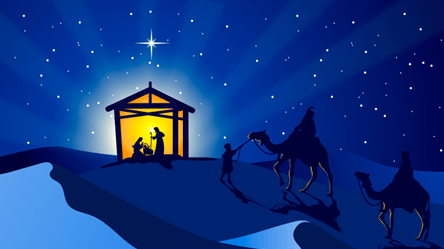
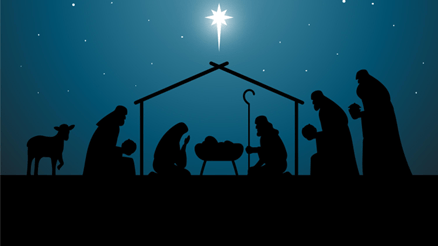
And here are a couple of different ones:

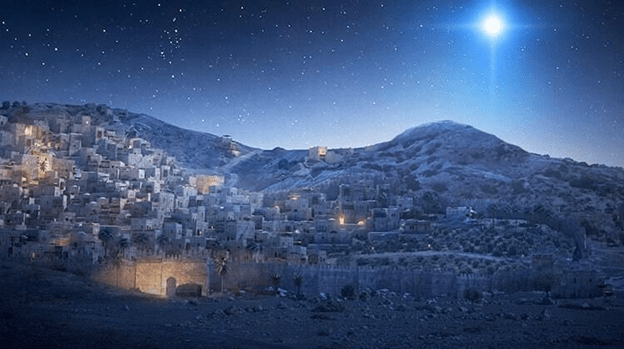
What’s the difference between the two of them? One is a quite solitary image, the other is one in community. Let’s listen to what one translation of scripture has to say about Jesus’ birth. It’s Luke 2: 1-7 and from the Common English Bible.
2 In those days Caesar Augustus declared that everyone throughout the empire should be enrolled in the tax lists. 2 This first enrollment occurred when Quirinius governed Syria. 3 Everyone went to their own cities to be enrolled. 4 Since Joseph belonged to David’s house and family line, he went up from the city of Nazareth in Galilee to David’s city, called Bethlehem, in Judea. 5 He went to be enrolled together with Mary, who was promised to him in marriage and who was pregnant. 6 While they were there, the time came for Mary to have her baby. 7 She gave birth to her firstborn child, a son, wrapped him snugly, and laid him in a manger, because there was no place for them in the guestroom.
The King James version, the Good News Translation, The English Standard Version all say a variation on, “And she brought forth her firstborn son, and wrapped him in swaddling clothes, and laid him in a manger, because there was no room for them in the inn. From that, we have the idea that Mary and Joseph searched through the village for somewhere to stay the night. Most scholars now agree that there is little evidence of inns in villages like Bethlehem at that time. People lived in multi-family compounds, with extended families and guestrooms, and the lower level would have been the place where the animals were brought in for safekeeping at night. Hospitality was and IS paramount in middle eastern culture, they would never have turned away a family member from shelter.
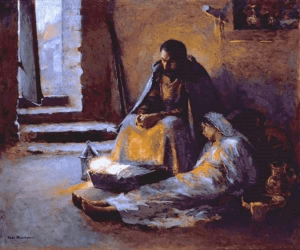
And because of the census, the village would have been full of people, and the guestroom probably had at least one family in it, if not more. So they were not cast off into roaming the streets looking for a place to stay but were given a corner of the lower level. A place where there were animals… and it was most likely warm and dry. So the issue wasn’t rejection—it was overcrowding. Have you even been in a barn where there are animals? It’s warm and dry. And there, sheltered from the cold, Mary gave birth to Jesus.
What else is missing from this picture? Or who is missing from this picture? Other women! I doubt that Mary would have given birth without a midwife… or aunties or sisters or cousins. I have no doubt that women were there, tending to Mary as she laboured to give birth.
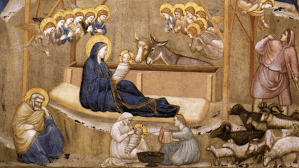
This image is a fresco painting titled The Nativity, created by the Italian master Giotto di Bondone around 1304-1306. And there are the midwives. For those of you who were at the Legends of Mary concert last week, you heard one of the midwives speak. While midwives didn’t make it into the gospels, they were in early Christian writing, as early as 150 CE. It’s interesting to ask why these women disappear from the gospel accounts. Was it political, societal, sexism?
Now we come to what one of my professors used to say, the ‘So What?’ So what does it matter if we think Jesus was born alone without help or in community? So what if this messes with my preconceived notions about Jesus’ birth? So what does this knowledge make a difference to our lives today? Maybe I should ask you that question? Does it make a difference if you imagine Jesus born into a warm, welcoming community of extended family rather than a lonely stable? For me, the lonely stable image plays into our western love of individualism, of managing on our own, and the disdain for those who can’t make it on their own. The other image lifts up mutual responsibility and care.
You have come to know how important the hospitality is to my whole concept of community, church, God and Jesus. Mutual responsibility and care are forms of hospitality. They say, I am willing to disrupt my life for you. And trust me, I am challenged by that deeply at this time of year when I field the many calls for help, when people are desperate and not at their best. I just keep telling myself either they are Jesus… or that Jesus would help them and I, through your generosity, am simply a conduit. I really try to have a conversation with folks who call looking for help, not to treat it as simply a transaction. And yes, there are those who show up more often than others, but Cathy and I both know who they are when they show up or call.
As people of faith, wee make choices, conscious and unconscious, about the kind of world we want based partly on what we believe about Jesus’ birth. We make choices about which politicians we support… what charities we support… and how we spend our money. Each one of those is a political decision. When I say political, I don’t mean party politics—I mean decisions about power, belonging, and responsibility. The story of Jesus’ birth is an inherently political one… Remember those words that Elana read earlier?
2 In those days Caesar Augustus declared that everyone throughout the empire should be enrolled in the tax lists. This first enrollment occurred when Quirinius governed Syria.
If that’s not political, I don’t know what is.
Jesus came… inn, stable, or lower level of a home. Perhaps at some point, scholars will discover more documents that will shed more light again… and we will have to rethink our images and ideas again…
Jesus came… are we waiting for a solitary figure to come to save us… or can we look around at each other… and realize that we all carry a spark of the divine light… that together, in community, we can be Jesus.
Jesus came… thanks be to God for the challenge and the opportunity, amen.
Luke 2: 1-7
December 21, 2025
Advent 4 – SJ
© Catherine MacDonald


 My Window on God's World