There were two parades that day.
If you stood in Jerusalem long enough,
you might have heard them both.
From one direction:
the steady rhythm of marching feet,
the creak of leather and harness,
the unmistakable sound of power on display.
From the other… a different kind of noise.
Not polished.
Not coordinated.
Not controlled.
Voices rising.
People shouting.
Branches rustling.
Hope spilling out into the street.
Two parades.
Two processions.
Two very different visions of what power looks like.
On the west side of the city, the empire made its entrance.
Pontius Pilate, the governor, arriving from Caesarea,
as he did every year during Passover.
Because Passover was dangerous.
It was a festival about liberation.
A story about slaves who became free.
A memory that stirred something deep in the bones of the people.
And Rome knew it.
So Pilate didn’t come quietly.
He came with cavalry.
With soldiers.
With armour that caught the sunlight
and reminded everyone watching
exactly who was in charge.
It was a parade of intimidation.
A message, clear and unmistakable:
Do not rise up.
Do not resist.
Do not forget who holds the power here.
Peace… but only the kind enforced by fear.
Order… but only the kind maintained by force.
And then, on the other side of the city… no war horse.
No armour.
No imperial banners.
Just Jesus of Nazareth.
Riding a donkey.
Not even his own donkey… a borrowed one.
A small, almost ordinary entrance.
Easy to miss, if you weren’t paying attention.
But the people noticed.
They always seem to notice.
They gathered.
They followed.
They took off their cloaks
and laid them on the road.
They cut branches from the fields
and waved them like signs of longing.
And they shouted: Hosanna. Save us.
Not “look how powerful we are.”
Not “we’ve got everything under control.”
But “we need help.”
“Something has to change.”
“God, come close.”
Two parades.
One built on dominance.
One built on dependence.
One declaring,
“We are in control.”
The other crying out,
“We are not… and we need saving.”
And if you were standing there that day,
you would have had to choose where to look.
Toward the spectacle… the polished strength of empire,
the certainty, the order, the visible might.
Or toward the vulnerability… the unarmed teacher,
the fragile hope of ordinary people,
the strange, unsettling possibility
that power might look like gentleness.
We like to think we would have chosen correctly.
We like to imagine ourselves
standing on the right side of history.
But the truth is… those choices don’t just belong to the past.
They show up again and again.
They show up wherever power gathers.
They show up wherever voices rise.
They show up wherever doors are opened or closed.
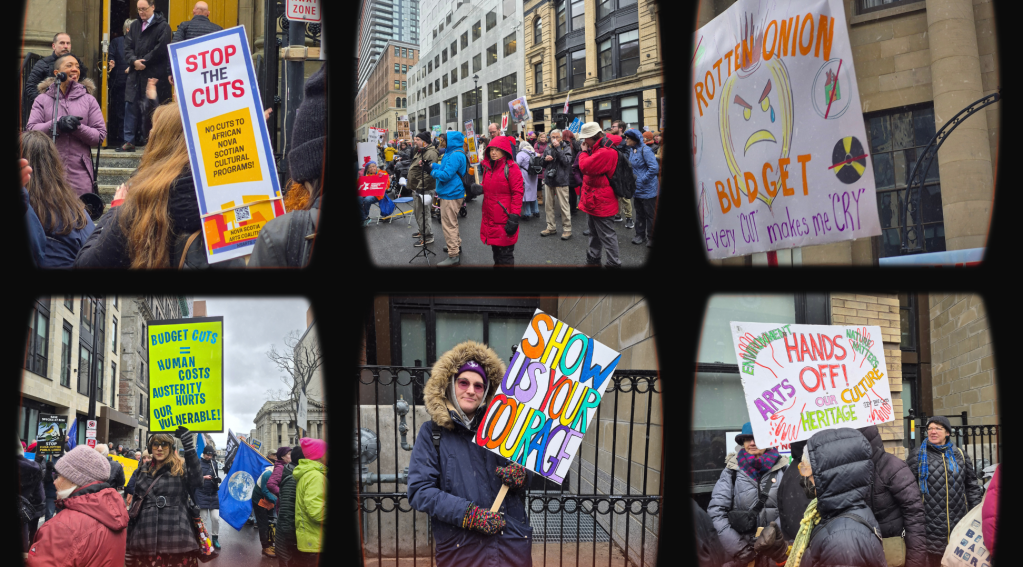
This week, in Halifax, there was another kind of moment.
No horses.
No palm branches.
But people gathered.
People raised their voices.
They sang.
They interrupted.
They insisted on being heard.
And in response the doors of Province House were closed.
Access was restricted.
The public was barred from entering.
The work of government continued
debates, decisions, proceedings.
but not everyone was allowed inside to witness it.
Now, it’s not the same as Jerusalem.
History doesn’t repeat that neatly.
But the echoes are there, aren’t they?
The tension between order and participation.
Between control and voice.
Between the desire to maintain stability
and the need to make space
for disruption,
for protest,
for people who refuse to be silent.
Two parades.
One says:
We must keep things moving.
We must protect the system.
We must maintain order… whatever it takes.
The other says:
Listen.
Pay attention.
There are voices that cannot be ignored.
And here is where it gets uncomfortable.
Because the line between those two parades
doesn’t run through history.
It runs through us.
Through our own instincts.
Our own fears.
Our own desire for things to be calm, predictable, under control.
There are days when we want Pilate’s parade.
When the world feels uncertain,
when conflict rises,
when things get messy… we long for clarity.
For strength.
For someone to take charge and say,
“This is how it will be.”
There is a comfort in that kind of power.
Even when it comes at a cost.
And then there are moments… quiet, persistent moments…
when something in us leans the other way.
Toward the donkey.
Toward the crowd.
Toward the voices crying out for something better.
Toward a kind of power that doesn’t silence, but listens.
That doesn’t dominate but draws near.
That doesn’t shut the doors but opens them wider.
Because that is the strange thing about Jesus of Nazareth.
He doesn’t arrive with the tools we usually associate with change.
No army.
No enforcement.
No threat.
Just presence.
Just compassion.
Just a refusal
to let fear have the final word.
And yet… that kind of power is harder to trust.
It feels fragile.
It feels risky.
It doesn’t guarantee quick results.
It doesn’t always keep things neat and orderly.
In fact, it often does the opposite.
It stirs things up.
It invites voices in.
It makes room for people
who have been pushed to the margins.
It looks less like a parade of certainty… and more like a movement of hope.
Yesterday, despite the fact that the budget had already passed, people gathered outside of province house to pray, to sing, to raise their voices in lament and hope… and to let each other know that WE ARE NOT ALONE!
So the question isn’t just what happened in Jerusalem.
And it’s not even just what happened this week in Halifax.
The question is what is happening right here.
Right now.
In us.
When we are faced with competing visions of power…
When we see doors closing or hear voices rising…
When we are asked, quietly or loudly,
to decide what kind of world we believe in…
Which parade do we follow?
Which procession do we join?
Do we stand with the kind of power
that protects itself at all costs?
Or do we move toward the kind of power
that risks openness,
that makes space,
that listens,
that saves?
Because one parade will always look stronger.
It will always seem more secure.
It will always promise order.
But the other one,
the quieter one,
the humbler one,
the one made of borrowed donkeys
and hopeful voices… that one carries something deeper.
Something that cannot be enforced.
Something that cannot be shut out
by closed doors.
It carries the possibility
that another way is still unfolding.
That power can look like love.
That leadership can look like service.
That salvation might arrive
not with force… but with compassion
walking slowly into the city.
Two parades.
They are still moving.
They are still passing by.
And somewhere along the road…we are choosing,
again and again, which one we will follow.
Thanks be to God for the challenge and the opportunity, amen.
© Catherine MacDonald 2026
Mark 11: 1-11
March 29, 2026 – SJ


 My Window on God's World