Last Sunday, those of us that were here, we heard Rev. Andrea Harrison speak about the United Church crest, and the words on it: That All May Be One and then the addition in 2012 of the Mohawk phrase: All My Relations.
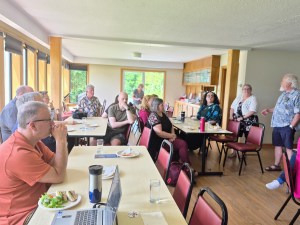
I look out at all of you for the first time as your minister and have many thoughts! There are only a few faces I recognize, most of them retired clergy! I don’t know you and you don’t know me. I have no idea which of the legacy churches you came from… what gifts for ministry you may have… what burdens you may be carrying… or what joys you are celebrating.
What I do know, is that we gather together because of Jesus. We are one because of his life, death and resurrection. That may mean something very different to one another, but Jesus is the heart and soul of a Christian community. And each one of us is here because we are all members of the body of Christ. No one more essential than the other. We hear this in the reading from 1 Corinthians 12
Paul is writing to the Christian community in Corinth around 53–55 CE, several years after he established the congregation. Corinth was a prosperous, diverse and cosmopolitan city, and the church reflected that diversity. There were different social classes, backgrounds, religious experiences and understandings of what it meant to follow Christ. This letter comes out comes out of a church that was deeply divided, even though it was a church with many gifts. The congregation had many spiritual gifts, but they were struggling with what those gifts meant. Some gifts, particularly dramatic or highly visible ones such as speaking in tongues, appear to have been regarded as more important or impressive than others. Paul wasn’t writing to a congregation that had figured out how to be one. He was writing to a congregation that was struggling to become one. That is why Paul’s central image in chapter 12 is the human body.
Listen to these ancient words for meaning for us today.
12 For just as the body is one and has many members, and all the members of the body, though many, are one body, so it is with Christ. 13 For in the one Spirit we were all baptized into one body—Jews or Greeks, slaves or free—and we were all made to drink of one Spirit. 14 Indeed, the body does not consist of one member but of many. 15 If the foot would say, “Because I am not a hand, I do not belong to the body,” that would not make it any less a part of the body. 16 And if the ear would say, “Because I am not an eye, I do not belong to the body,” that would not make it any less a part of the body. 17 If the whole body were an eye, where would the hearing be? If the whole body were hearing, where would the sense of smell be? 18 But as it is, God arranged the members in the body, each one of them, as he chose. 19 If all were a single member, where would the body be? 20 As it is, there are many members yet one body. 21 The eye cannot say to the hand, “I have no need of you,” nor again the head to the feet, “I have no need of you.” 22 On the contrary, the members of the body that seem to be weaker are indispensable, 23 and those members of the body that we think less honorable we clothe with greater honor, and our less respectable members are treated with greater respect, 24 whereas our more respectable members do not need this. But God has so arranged the body, giving the greater honor to the inferior member, 25 that there may be no dissension within the body, but the members may have the same care for one another. 26 If one member suffers, all suffer together with it; if one member is honored, all rejoice together with it.
Beautiful sentiments right? The body as a community of faith is a wonderful metaphor… but like all metaphors it has its limits… What if in your legacy church… you were a foot… and this new entity that we are all a part of has an abundance of feet? The answer isn’t to decide which foot gets to stay. The answer is to discover what all these feet can do when they belong to the same body. Or what if you were an ear… and there are so many ears now… are you cut off from the body? Of course not! The metaphor can be stretched and understood in new ways.
Last weekend, at a clergy retreat, I was reminded by our facilitator, the Rev. Dr. Matthew Anderson, of a book on my shelf: The Brain that Changes Itself by Norman Doidge. The book explores the science of neuroplasticity, the brain’s ability to change its structure and function in response to experience, learning, practice, and injury. Through stories of people recovering from strokes, adapting to sensory loss, overcoming neurological difficulties, and developing new abilities, Doidge shows that the brain is not as fixed as scientists once believed. Instead, different parts of the brain can sometimes take on new functions, create new connections, and develop new pathways. The book’s central message is one of possibility and adaptation: while the brain has real limitations, our brains retain a capacity for change throughout life, and purposeful practice, relationships, environment, and new experiences can help shape that change.
Matthew Anderson, a pilgrim leader and writer, had a stroke two years ago, found himself unable to walk or write! He is doing both again, by forging new neural pathways. We too can forge new pathways in how we are the body of Christ. Right now, at this early stage of amalgamation, you may feel much like 3 distinct congregations. Through time and attention, we will become one cohesive congregation.
How will we do that? A new pathway isn’t created because we say we have one. It is created because we use it. Again and again. We practise listening to someone whose church history is different from ours. We sit beside someone we don’t know. We learn a new tradition. We try a different way of doing something. We share a meal. We pray together. We discover someone’s gift. We make room.
I have one more piece of scripture to share with you; this time from Acts 2:42–47
42 They devoted themselves to the apostles’ teaching and fellowship, to the breaking of bread and the prayers. 43 Awe came upon everyone because many wonders and signs were being done through the apostles. 44 All who believed were together and had all things in common; 45 they would sell their possessions and goods and distribute the proceeds[j] to all, as any had need. 46 Day by day, as they spent much time together in the temple, they broke bread at home and ate their food with glad and generous hearts, 47 praising God and having the goodwill of all the people. And day by day the Lord added to their number those who were being saved.
Notice what creates this community. It isn’t a constitution. It isn’t a governance model. It isn’t a new organizational chart. It is what they do together. They learn together… They pray together… They eat together. They share what they have… They make room for others… Day after day, they practise being a community.
And so we come to this table today, on World Communion Sunday. At this table, we don’t have to leave our histories at the door. We don’t have to decide which congregation matters most. We don’t have to become identical. Instead, perhaps the question for us is not, ‘Which congregation gets to have a place at the table?’ Perhaps the question is, ‘Who is still missing from the table?’” At Christ’s table, our differences are not erased but gathered, blessed and woven into the one body we are becoming.
Thanks be to God for the challenge and the opportunity, amen.
1 Corinthians 12: 12-26
Acts 2: 42-47
October 4, 2026 – Harbour United Church
World Communion Sunday


