The question that came to me when I first started pondering this passage is this: When power is abused, will we protect the powerful, or will we have the courage to tell the truth and seek justice? I’ll say it again: When power is abused, will we protect the powerful, or will we have the courage to tell the truth and seek justice? Keep that in mind as we explore the story of David and Bathsheba, and Nathan, one of the court’s prophets.
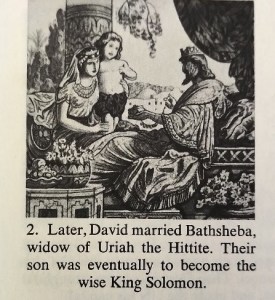
What do you know about the story of David and Bathsheba? And how do you know it? Is it from movies? Art? Music? Is it from some almost forgotten Sunday School lesson? There is no doubt that David was a great king in many ways… and he was also deeply flawed. He was the shepherd king… the one who slew the giant Goliath… he united Judah and Israel, bringing the Ark of the Covenant to Jerusalem, making it the centre of worship and ruled peacefully for many years… But that’s not all he was…
The photograph up on the screen is from The Bible in Pictures, my siblings and I received it for Christmas in 1966 and I LOVED it. Apparently, I was a Bible nerd from way back. An interesting detail of this Bible is that it starts with the story of Jesus, not creation! But, if you know anything about the Biblical story of David and Bathsheba, you will know that this photograph skips over about 2 long chapters of their story.
A story that encompasses a forced sexual encounter, betrayal, murder and death of a baby. Not exactly child bible friendly. One of the things, I think we sometimes forget, in our completely understandable desire to protect our children from these kinds of stories, is that they already hear about, or even experience these kinds of things. We can lay our stories, alongside the Biblical story and look for grace and redemption, even in the difficult stories.
The reading is fairly long, so I’ve taken the liberty of summarizing it, without losing its essential meaning.
In the spring, when kings went off to war, David sent Joab, his servants, and the Israelite army to fight the Ammonites, while he remained in Jerusalem. One evening, David was walking on the roof of his palace when he saw a beautiful woman bathing. He sent someone to find out who she was and learned that she was Bathsheba, the wife of Uriah the Hittite, one of his soldiers. Despite knowing she was married, David sent messengers to bring her to him and had sex with her. Bathsheba returned home and later sent word to David that she was pregnant.
David summoned Uriah from the battlefield, asking him about the army and the progress of the war. He then encouraged Uriah to go home and spend time with his wife, hoping Uriah would sleep with Bathsheba and believe the child was his. However, Uriah refused to go home. He explained that while the other soldiers were living in tents and enduring the hardships of war, he could not enjoy the comforts of his own home. Instead, he slept at the entrance of the palace with the king’s servants. David tried again the next day. He invited Uriah to eat and drink with him and made him drunk, hoping this would persuade him to go home. But Uriah still refused to visit his wife and once again slept alongside the king’s servants.
David then resorted to a far more sinister plan. He wrote a letter to Joab, instructing him to place Uriah at the front of the fiercest fighting and then withdraw the other soldiers, leaving Uriah exposed to the enemy. David sent this letter with Uriah himself, who unknowingly carried his own death warrant. Joab followed the king’s instructions, and Uriah was killed in battle, along with other Israelite soldiers. Joab sent a messenger to report the battle’s outcome to David, anticipating that the king might be angry about the soldiers’ deaths. When the messenger confirmed that Uriah had also been killed, David showed no remorse. He told Joab not to be troubled by the losses and encouraged him to continue the attack.
When Bathsheba learned that her husband was dead, she mourned for him. After the period of mourning ended, David brought her into his household, and she became his wife. In time, she gave birth to a son. But what David had done was evil in the Lord’s eyes.
Right there, we have an anomaly, in the ‘time when kings go out to battle,’ David stays home. Setting aside whatever our feelings are about war, it was the king’s duty to keep his subjects safe and for David to remain safely in Jerusalem, was already a dereliction of his duties as king. But you wouldn’t know that, unless you knew some of the history.
A few lines from Leonard Cohen’s song Hallelujah kept ringing in my ears this week as I thought about this text:
Your faith was strong but you needed proof
You saw her bathing on the roof
Her beauty and the moonlight overthrew her. (Leonard Cohen, Hallelujah)
Leonard Cohen was wrong! You might not have noticed that it’s King David that sees her FROM the roof, NOWHERE does it say that Bathsheba is on the roof! The king’s palace would be the highest building there was and would provide a vantage point for his to see all around. Bathsheba wouldn’t be engaging in the ritual act of purification in public. Setting aside our notions of clean and unclean, a ritual bath after menstruation was and continues to be a religious practice for many Jewish women. But it would be done in private, not public. King David may have seen her through a window.
Drs. Amy Robertson and Bobby Williamson on The Bible Worm podcast had quite a discussion about whether it was important to include the piece about the ritual purification, and concluded that it was important, to demonstrate that there could be no doubt about the paternity of her child. It could only be King David’s.
This part of the text demonstrates David’s attempt to palm off Bathsheba’s pregnancy on her husband. But Uriah does not comply. So, King David doubles down on his treachery towards his trusted general. Imagine being forced to marry someone who had forced themselves on you? Imagine being taken by the king, having no real power to refuse him, and then being brought into his household as his wife. What would that mean for your life? What choices did Bathsheba actually have? We cannot know exactly what she experienced, because the text does not tell us. And that silence is part of what makes this story so troubling. Kings had absolute power over everyone.
Even so, one of David’s advisors, the prophet Nathan still had enough courage to stand up to him. Like Jesus did in his lifetime to illuminate an idea, Nathan told a story, it’s in chapter 12:
12 1 The LORD sent Nathan to David. He came to him and said to him, “There were two men in a certain city, the one rich and the other poor. 2 The rich man had very many flocks and herds, 3 but the poor man had nothing but one little ewe lamb that he had bought. He brought it up, and it grew up with him and with his children; it used to eat of his meager fare and drink from his cup and lie in his bosom, and it was like a daughter to him. 4 Now there came a traveler to the rich man, and he was loath to take one of his own flock or herd to prepare for the wayfarer who had come to him, but he took the poor man’s lamb and prepared that for the guest who had come to him.” 5 Then David’s anger was greatly kindled against the man. He said to Nathan, “As the LORD lives, the man who has done this deserves to die; 6 he shall restore the lamb fourfold because he did this thing and because he had no pity.” 7 Nathan said to David, “You are the man!
What a horrible, horrible story isn’t it? Where is the love, the justice, the mercy? And why is this a story we need to hear? David forgot about God… he forgot that kings were supposed to have the best interests of their people as their primary purpose. He forgot that he had been anointed by Samuel in a holy ritual and he was to care for and protect his people. He forgot everything but his own wants and desires.
Sometimes, biblical stories and passages raise more questions than answers, in fact, that is often the case.
Questions like:
• When power is abused, will we protect the powerful, or will we have the courage to tell the truth and seek justice?
• Whose account of events gets believed when a powerful man and a woman tell different stories?
• How do institutions protect their reputations at the expense of those who have been harmed?
• What does it mean to speak truth when doing so may cost someone their position, security or sense of belonging?
• And, perhaps most importantly, who is willing to be Nathan, the person who confronts David and says, “You are the man”?
A quote that is often attributed to Martin Luther King Jr: “In the end, we will remember not the words of our enemies, but the silence of our friends.” I think that’s something we can learn… when we have power, or are in a position of perceived authority, we are not there to get our own way. We have all encountered people who just want to get their own way… people with power… and we read or hear stories both historic and contemporary of leaders who succumb to lure of their power.
Perhaps the grace in this difficult story is this: God does not allow David to hide forever behind his crown, his reputation or the stories people tell about him. God sends Nathan to confront him with the truth. David is forced to see himself as others might see him. He must acknowledge what he has done. Grace does not mean pretending that David is not responsible. It does not mean that Bathsheba’s suffering or Uriah’s death matter any less. Grace begins when the truth can finally be spoken, when wrongdoing is acknowledged, and when there is an opening for repentance and change. The consequences of David’s actions do not end with Uriah’s death. The child Bathsheba bears becomes ill and dies. Later, violence and conflict tear through David’s own family. This is a deeply troubling part of the story, raising questions about suffering, justice and the consequences of human wrongdoing. It does not offer us easy answers, and perhaps we should resist the temptation to make it do so. Nathan confronted David, and David finally acknowledged, “I’ve sinned against the Lord!” That is where the possibility of repentance begins. Not with excuses. Not with protecting his reputation. Not with pretending that what happened was somehow acceptable. It begins with the truth.
Psalm 51 gives us words for the difficult work of repentance:
1 You are kind, God!
Please have pity on me.
You are always merciful!
Please wipe away my sins.
2 Wash me clean from all
of my sin and guilt.
3 I know about my sins,
and I cannot forget
the burden of my guilt.
4 You are really the one
I have sinned against;
I have disobeyed you
and have done wrong.
So it is right and fair for you
to correct and punish me.
5 I have sinned and done wrong
since the day I was born.
6 But you want complete honesty,
so teach me true wisdom.
7 Wash me with hyssop[a]
until I am clean
and whiter than snow.
8 Let me be happy and joyful!
You crushed my bones,
now let them celebrate.
9 Turn your eyes from my sin
and cover my guilt.
10 Create pure thoughts in me
and make me faithful again.
“But you want complete honesty, so teach me true wisdom.” Complete honesty. What a challenging idea. It means telling the truth even when the truth threatens our reputation. It means listening when someone tells us that our actions have caused harm. It means being willing to see ourselves not as we wish to be seen, but as we really are. And it means that when someone else has the courage to speak the truth, we do not turn away, silence them or protect the powerful simply because it is more comfortable. Perhaps that is one of the most important lessons in this story.
We need Nathans, people willing to confront wrongdoing. We need communities willing to listen to those whose stories have been overlooked. And we need leaders willing to hear the words, “You are the one,” without using their power to silence the messenger.
Because the question is not simply whether we have the courage to speak truth to power. The question is also whether, when the truth is spoken to us, we have the humility to listen, the courage to take responsibility, and the willingness to change. God’s grace does not ask us to pretend that harm has not happened. It invites us to face the truth and begin again, with honesty, compassion and a renewed commitment to justice. So may we have the courage to speak the truth, the humility to hear it, and the faith to believe that even difficult truths can open the way to transformation.
Thanks be to God for the challenge and the opportunity of being one of her people. Amen.
2 Samuel 11:1-5, 26-27; 12:1-9
Psalm 51:1-10
October 25, 2026 – Harbour United


